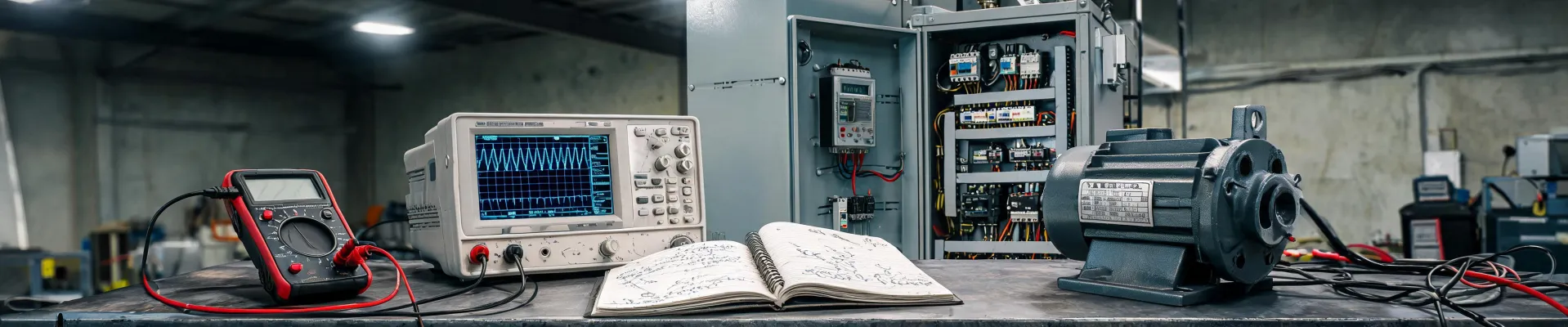
When I took over purchasing for our 130-person electrical service contractor in 2020, I thought my main job was to find the lowest Hioki multimeter price. That turned out to be wrong in a more expensive way than I expected.
I'm an office administrator, not an engineer. I manage all the test-equipment and instrument ordering for the company—roughly $50,000 a year across eight vendors. We buy multimeters, clamp meters, bulk sensors, accessories, and calibration services. I report to both operations and finance, so an order has to make sense twice: technically for the people using it and financially for the people paying for it.
The first price I compared wasn't the real price
The first time I ordered 40 multimeters, I used a very simple method. I got three quotes, compared the per-unit numbers, and gave the purchase order to the lowest bidder.
Six weeks later, the invoice was 14% above the quote I had approved.
The winning quote had a low unit price, but it didn't include the NIST-traceable calibration certificate our quality manager requires. I had assumed that writing 'calibration certificates' on the RFQ would make the supplier include them. They interpreted it as the standard factory calibration that already came with the instrument. Same words, different meanings. Add $38 per unit for the certificates, plus freight and handling that weren't itemized in the original quote, and suddenly the 'cheap' supplier wasn't cheap.
Honestly, I'm not sure why some suppliers quote a low base number and then add fees later. My best guess is that a lower first number gets them into the conversation. But it doesn't make the comparison honest. It makes the buyer look bad internally when the final invoice shows up.
The deeper problem: a Hioki multimeter price without scope is meaningless
My first mistake was treating a multimeter quote as if it were a quote for a box of industrial gloves. It isn't that simple.
Hioki multimeter is not one thing. It is a family of instruments—handheld digital multimeters, clamp meters, insulation testers, and electrical testers with different ranges, capabilities, and accessories. A quote could be for a bare instrument. Another quote for what looks like the same product could include test leads, a carrying case, a temperature probe, software, or a calibration certificate. The difference between those two quotes is not price. It is scope.
There is also the safety rating question. Per IEC 61010-1, measurement category ratings matter. A meter rated CAT II is not the same as a meter rated CAT III, even if the body looks similar. If a quote doesn't state the category rating or the standard it was tested to, you are not comparing two versions of the same product. You are comparing two different risk profiles.
Why multimeter OEM and private label are different decisions
The problem gets bigger when you are buying for resale or for a branded product line. Terms like multimeter OEM and private label are often used as if they mean the same thing. They don't.
In my experience, an OEM project usually means the instrument is made to the buyer's specification. That might involve custom ranges, connectors, data output, firmware behavior, or extra documentation and testing. A private-label project usually means an existing clamp meter or multimeter is rebranded with your logo, packaging, and manual. Both are legitimate. But they have completely different cost structures.
If you are researching clamp meter OEM vs private label, ask the supplier which process they are quoting. The answer changes engineering cost, minimum order quantity, certification responsibility, product liability, and lead time. If someone gives you a price for a 'branded clamp meter' without telling you which model and which level of customization is included, you don't have a quote yet. You have a guess.
Bulk sensor orders are the same problem in a different wrapper. A sensor is not a generic part. A temperature probe can have different probe types, cable lengths, connector styles, and measurement ranges. A current sensor can be a rigid jaw, a flexible loop, or a clamp with a completely different output. When I order bulk sensors, I now need model numbers and connector types on the quote. If that information isn't there, the mismatch cost shows up later—usually in the form of probes that don't connect to the meters we just bought.
What ambiguity really costs a buyer
The invoice story cost me about four hours of emails and one uncomfortable conversation with my VP. That was annoying, but it wasn't the real cost.
The real cost happens when ambiguous quotes reach an audit or a safety review. A test instrument without the correct calibration documentation is not a usable test instrument for us. A meter without the right safety category is not just an inconvenience—it's a hazard. Once that becomes clear, the order stops being a transaction and becomes a project.
The biggest surprise in our 2024 vendor consolidation was not the price gap between suppliers. It was that the most expensive quote on paper was the only one that included warranty administration, calibration coordination, and a documented compliance path. That quote looked worse at the bottom of a spreadsheet. It cost us less by the end of the year.
The fix: treat the final number as the price
I still care about Hioki multimeter price. But now I care about the final number, not the first number. Before I compare quotes, I need to know what is actually included.
- The exact product specification. Model number, datasheet revision, and IEC 61010 category rating.
- The full scope of delivery. Probes, leads, sensors, carrying case, software, and calibration certificates.
- The commercial terms. Freight, insurance, payment terms, warranty handling, and return policy.
- The branding or customization route. Is this a standard named-brand product, an OEM build, or a private-label version of an existing instrument?
A transparent quote may not look like the lowest option. But I have learned that the supplier who lists fees upfront—even when the total is higher—usually costs less in the end. With test instruments, trust is not a soft skill. It is a line item.
So ask what's not included before you ask what's the price. That is the question that turns a low Hioki multimeter quote into an actual bargain.

Rebecca Sloan
Rebecca Sloan is a power distribution and protection analyst specializing in circuit breakers, switchgear, contactors, fuses, surge protective devices, and coordination. She applies IEC 60947-2 breaker requirements, IEC 60269 fuse characteristics, and IEC 61643-11 tests while examining rated voltage, breaking capacity, time-current curves, selectivity, and prospective short-circuit current. She helps engineers and buyers compare protective devices against documented fault levels, installation conditions, maintenance access, and continuity priorities.