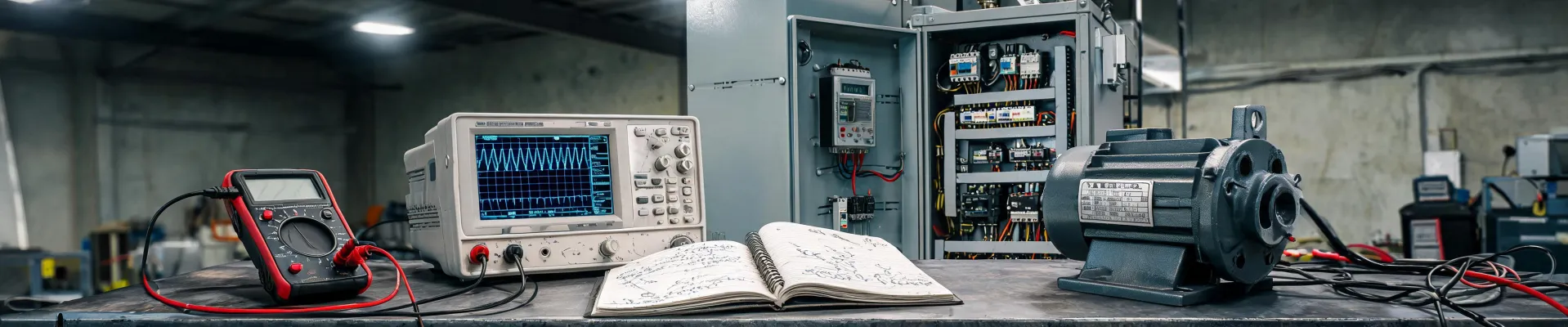
I've been handling electrical tester and sensor procurement for wholesale orders for 9 years. I've personally made (and documented) 11 significant mistakes, totaling roughly $18,400 in wasted budget. Now I maintain our team's pre-check list. Here's the version I wish someone had handed me in 2017.
The surface problem: everyone thinks it is about the price
When buyers start sourcing, the first question is usually some version of: what is the best Hioki multimeter price? Or: who has the lowest electrical tester wholesale quote? Or: can we get a better rate on this bulk sensor order?
I get it. Price is visible. It fits in a spreadsheet. It makes you look efficient in a review meeting.
But after enough bad orders, I started to see a pattern. The expensive mistakes rarely came from paying $8 too much per unit. They came from buying the wrong thing confidently, then discovering it after the cartons arrived.
Price is easy to compare. Specs are not.
The deeper problem: your quote is not a specification
In September 2022, we placed a 240-unit order for clamp sensors and testers. The quote looked fine. The product page said True RMS, CAT III 600V, and compatible with standard multimeters. I checked it myself. I approved it. I processed it.
Then the first production batch failed. The sensor connector was a recessed safety jack. Our test leads used a standard banana plug. Not the same thing. Not even close.
Every single unit had the issue. We caught it during incoming QC, not at the customer site, which saved us from a worse mess. Still, the redo cost about $3,200, plus a 3-day production delay and a very uncomfortable call with our internal team.
That order changed how I think about an electrical tester specification guide. A quote is a price. A specification is a contract. Too many buyers treat them as the same document.
I am not a metrology engineer, so I cannot speak to calibration lab uncertainty budgets or laboratory traceability chains. What I can tell you from a procurement perspective is simpler: if the spec is ambiguous, the cheapest quote is not cheaper. It is just unpriced risk.
What the spec sheet usually leaves out
Most first-pass spec sheets tell you enough to make a decision, not enough to protect an order. I have learned to look for the missing lines:
- Accuracy format: ±(% of reading + digits), not just high precision.
- Safety rating: CAT II, CAT III, or CAT IV, and at what voltage.
- True RMS: over what crest factor and bandwidth.
- Sensor interface: connector type, thread, output signal, excitation voltage, cable length, and IP rating.
- Calibration: certificate included or extra, traceable or not, interval and acceptance criteria.
- OEM terms: logo, packaging, manual language, carton marks, barcode, sample approval, and MOQ.
The word compatible is not a specification. It is a hope with a part number.
The real cost of a vague spec
Here is what a wrong bulk sensor order actually costs. It is not just the unit price difference. It is rework labor, return freight, customs friction, replacement calibration, production rescheduling, and the internal credibility hit when you have to explain why the line is waiting.
On a $3,200 order, we lost the redo cost plus a week of schedule confidence. On a smaller trial order, the damage can be worse proportionally. I once saw a $310 first order go wrong because the vendor shipped a generic sensor cable instead of the shielded version we specified. The unit price was great. The trial failed. That customer never came back.
I went back and forth between the cheapest quoted Hioki multimeter price and a slightly higher quote with documented calibration certificates for two weeks. The cheap option offered about 12% savings. The other option had a written spec, traceable calibration, and clear OEM/private-label terms. Ultimately I chose the documented quote because the project was too important to gamble on a PDF.
Looking back, I should have written every requirement into the purchase order. At the time, the vendor's product page seemed clear enough. It was not.
Why this hits small orders hardest
Small orders are where vague specs do the most damage. A five-unit trial, a ten-sensor sample, a first run for a new distributor. These orders are small in revenue but huge in learning value.
Some suppliers treat them like an annoyance. I understand volume economics. I do not expect small orders to get the same unit price as a container load. But I do expect the same clarity. Small does not mean unimportant. It means potential.
When I was starting out, the vendors who treated my $200 orders seriously are the ones I still use for $20,000 orders. The ones who said send us a PO and we will figure it out were usually the ones who caused the rework.
The pre-check list we use now
This is the short version. It is not perfect, but it has caught 47 potential errors in the past 18 months.
- Application first. What are you measuring? Voltage, current, inrush, harmonics, temperature, or sensor output? If you cannot answer that, no price is good.
- Safety category. Confirm CAT rating, voltage, pollution degree, and applicable standards. Do not accept CAT III as a vibe.
- Accuracy and resolution. Get the exact formula, counts, True RMS bandwidth, crest factor, and temperature coefficient.
- Sensor and interface. For any bulk sensor order, request a dimensional drawing and connector spec. Match it to your tester before you pay.
- Calibration and documentation. Ask whether calibration is included, traceable, and accepted by your customer's audit. Get it in writing.
- OEM and private label. Confirm logo, packaging, manual language, carton marks, barcode, sample approval, and change-control process.
- Acceptance criteria. Define QC sample size, test method, pass/fail limits, and remedy if the lot fails. Put it in the PO.
According to FTC advertising guidelines (ftc.gov), claims must be truthful, not misleading, and substantiated with evidence. That applies to product pages too. If a supplier claims high precision or CAT III protection, ask for the document behind the claim. If they cannot provide it, treat the claim as marketing, not engineering.
When comparing electrical tester wholesale quotes, ask for total delivered cost: unit, calibration, probes, sensors, freight, duties, warranty support, and OEM setup. Then compare the specs line by line. Price is one column. Risk is the rest of the sheet.
Bottom line
If you are chasing a better Hioki multimeter price, a lower electrical tester wholesale rate, or a cheap bulk sensor deal, pause first. The number is not the problem. The missing specification is.
Write the spec. Confirm the interface. Document the calibration. Put it in the PO.
Then price becomes a simple math problem.
That is it. Simple.

Mateo Alvarez
Mateo Alvarez is a switchboard and wiring-device analyst covering electrical panels, distribution boards, control panels, switches, industrial plugs, sockets, and outlets. He uses IEC 61439-1 and IEC 61439-2 verification evidence plus IEC 60309 ratings to examine temperature rise, short-circuit withstand, busbar capacity, rated current, creepage, clearance, and enclosure integration. He helps designers and procurement teams match assemblies and connection devices to load diversity, installation access, maintainability, and declared operating conditions.