Measurements by working environment

Hioki Multimeter application coverage from bench circuits to facility feeders

Instrument selection changes with the test point, transient exposure, conductor access, expected waveform, environmental conditions, and the procedure used by qualified personnel. This application map helps purchasing and engineering teams capture those differences before comparing models.

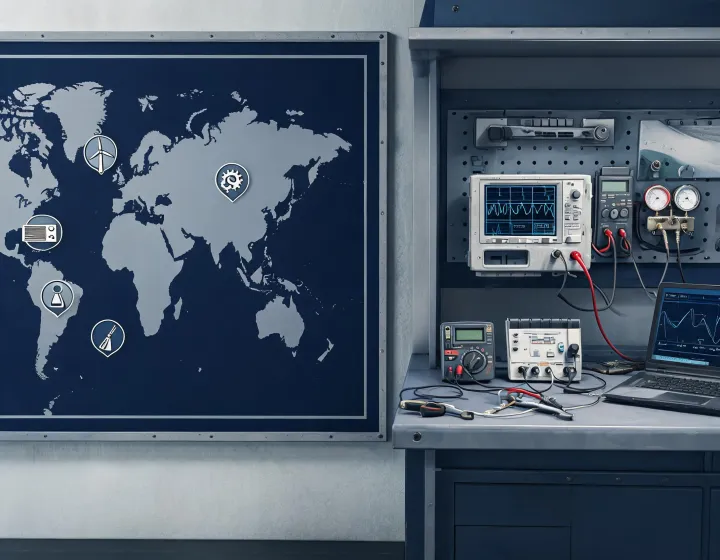
Electrical measurement application map

Regional work patterns, one documented selection method

01

North American facility service

Commercial and industrial technicians frequently move between branch circuits, motor controls, distribution panels, and HVAC equipment. Record nominal and maximum voltage, CAT environment, prospective transient exposure, required functions, and accessory ratings. The meter, probes, clips, and fuses must be considered as one measurement system.

  • Typical tasks: true-RMS voltage, current, capacitance, frequency, and continuity
  • Verify: exact model manual, lead category, fuse specification, and local work procedure
02

European industrial maintenance

Machine commissioning and maintenance may involve variable-frequency drives, control loops, protective earth checks, and cabinet troubleshooting. Bandwidth, low-pass filtering, input impedance, resolution, and electromagnetic environment can affect the usefulness of a reading. CE or RoHS references must be confirmed for the exact model and market.

  • Typical tasks: drive output checks, resistance, diode testing, and 4–20 mA loops
  • Verify: waveform behavior, environmental limits, documentation language, and calibration needs
03

Asia-Pacific production and laboratories

Electronics production, incoming inspection, and maintenance benches often value repeatability, logging, stable resolution, and efficient fixture connections. Basic accuracy alone does not describe the whole method; range, test current, settling time, burden voltage, and reference conditions may also matter.

  • Typical tasks: component checks, DC measurements, temperature, and recorded trends
  • Verify: tolerance budget, interface compatibility, calibration interval, and traceability
04

Energy and field installations

Solar arrays, battery systems, utility service work, and remote assets introduce higher DC voltages, outdoor exposure, long conductors, and difficult access. Selection must follow the actual installation and procedure, including voltage polarity, CAT rating, clamp jaw capacity, ingress protection, temperature, and safe isolation practices.

  • Typical tasks: DC voltage, leakage current, insulation checks, and load trending
  • Verify: input limits, PPE plan, environmental rating, and suitable accessories

Application demand profile

Industrial maintenanceFunction breadth, CAT context, rugged leads
Panel commissioningControl signals, continuity, traceable records
HVAC serviceCapacitance, temperature, microamps, clamps
Laboratory verificationAccuracy budget, resolution, logging, calibration

These bars describe the relative breadth of selection questions, not product performance claims. A defensible choice still depends on the exact test procedure, model specifications, accessories, and operating conditions.

Map your measurement task before requesting a model

Share the circuit context, expected range, functions, safety category, accessory needs, environment, quantity, and destination. We will separate confirmed requirements from items that still need field or documentation review.